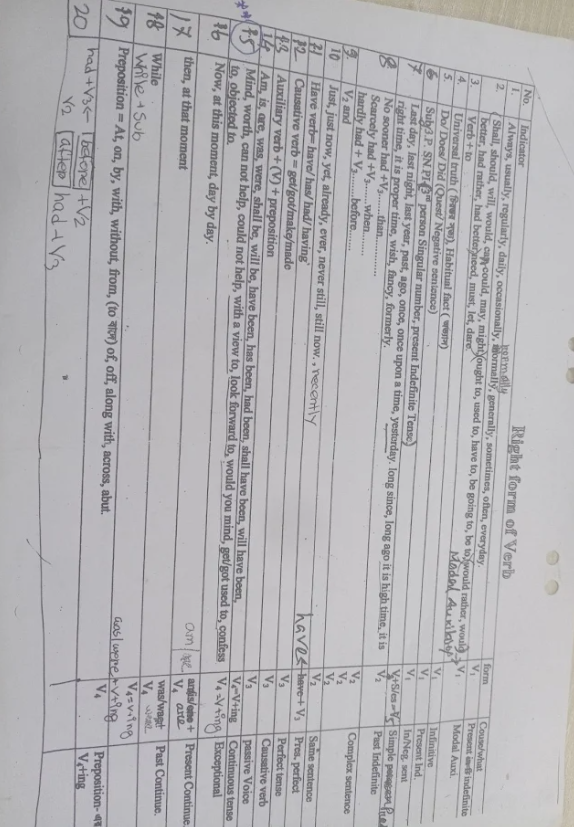

✅ Right Form of Verb – Rules & Usage Table
| # | Usage Context | Verb Form / Rule | Example Sentence |
|---|---|---|---|
| 1 | Universal truth, habitual action, general facts | Base Verb (V¹) | The sun rises in the east. |
| 2 | Frequency adverbs: always, never, daily, every, sometimes, regularly | Base Verb (V¹) | He gets up early. |
| 3 | Present action happening now (with: now, at this moment, look, listen) | am/is/are + V⁴ | Look! The baby is crying. |
| 4 | Past time reference (yesterday, last, ago, once, in 1990, etc.) | Past Verb (V²) | He went to school yesterday. |
| 5 | Past continuous (one action was ongoing when another happened) | was/were + V⁴ | While he was reading, I entered the room. |
| 6 | Recent past with: just, already, yet, ever, never, since, for, recently | has/have + V³ | He has done the work just now. |
| 7 | Past perfect with: before, after, when, until, as soon as | had + V³ | He had done the work before I came. |
| 8 | Future action (tomorrow, soon, next week, in future) | shall/will + V¹ | I will go to school tomorrow. |
| 9 | Future perfect (by, within, before, after) | shall/will have + V³ | He will have done the work by this time. |
| 10 | 1st Conditional Sentence | If + V¹, will + V¹ | If you work hard, you will succeed. |
| 11 | 2nd Conditional (unreal present) | If + V², would/could + V¹ | If I were a bird, I would fly. |
| 12 | 3rd Conditional (unreal past) | If + had + V³, would have + V³ | If he had tried, he would have won. |
| 13 | After: It’s time, wish, as if, as though | Past Verb (V²) | I wish I were rich. |
| 14 | Subjunctive mood (suggest, propose, recommend, demand, order) | Base Verb (V¹) | I suggest that he go home. |
| 15 | Modal-like verbs: need, dare (sometimes without ‘to’) | need/dare + V¹ | He need not go there. |
| 16 | Expressions: had better, would rather, rather than, sooner than | Base Verb (V¹) | You had better leave now. |
| 17 | Causative: let, make, see, hear, feel, help, watch, notice, bid, behold | Bare Verb (V¹) | I made him go. |
| 18 | Help (to is optional) | V¹ / to + V¹ | I helped him (to) do the work. |
| 19 | Used to / would (for past habits) | Base Verb (V¹) | I used to walk every morning. |
| 20 | Suggestions: shall we…? why don’t you…? how about…? | V⁴ (verb+ing) | How about taking tea? |
| 21 | After: look forward to, be used to, addicted to, accustomed to | V⁴ (verb+ing) | I look forward to meeting you. |
| 22 | Causative verbs: have, get | have/get + object + V³ | I got my hair cut. |
| 23 | After verbs: prevent, avoid, mind, can’t help, get used to | V⁴ (verb+ing) | He avoids telling lies. |
| 24 | Verbs: suggest, enjoy, practice, admit, deny, involve, consider, finish, risk | V⁴ (verb+ing) | I enjoy reading novels. |
| 25 | After prepositions (on, of, at, in, to, etc.) | V⁴ (verb+ing) | He is good at writing. |
Day Care School and College, Dhaka
English II (Grammar)—Change the form of verbs
-
- He has been reading a book.
- Did he buy a pen?
- They have written a letter.
- She had seen a snake.
- He has played cricket.
- She went to market.
- The boy played football.
- My father had taken food.
- They will come tomorrow.
- He has gone to school.
- They were flying kites.
- He had written a letter.
- You had finished your homework.
- We had taken our meal.
- The teacher had gone to class.
- They had done the sum.
- He had called his friend.
- He went to college.
- I have read the book.
- Has he taken food?
- Nobody helps me.
- He has already completed this.
- Nobody could do it.
- He does not respect his parents.
- Who broke the glass?
- Where does he live?
- What did you see?
- She did not know him.
- He will not play.
- You do not like him.
- She does not like him.
- He had written a letter.
- He has read the book.
- The man has died.
- She had read the book.
- He had gone to college.
- Rina had called me.
- She went to market.
- We went to college.
- One who shall take a lot of money for a bottle of wine.
-
- Two hours (to be) a long time to wait to see a doctor.
- 93,000,000 miles (to be) the distance from the sun to the earth.
- Cattle (to be) grazing in the field.
- Three dozen (to make) thirty-six.
- The peasantry in Bangladesh (to be) poor.
- The jury (to be) unanimous in their opinion.
- The jury (to be) divided in their opinions.
- The United States of America (to be) a rich country.
- Gulliver’s Travels (to be) an interesting book.
- The Arabian Nights (to be) still very favorite.
- Some people in my office (to be) very annoying.
- Few mountain climbers (to have) successfully reached the peak of Mt. Everest.
- Both (to be) happy.
- All five men (to be) hard workers.
- Many people (to be) not hard workers.
- All that glitters (to be) not gold. Or, All’s well that (to end) well.
- The rich (to be) not always happy.
- The virtuous (to be) happy.
- That Shakespeare was a great dramatist (to be) known to all.
- Walking (to be) a good exercise.
- To play (to be) a good exercise.
- One of the boys (to be) absent.
- It is I who (to be) responsible.
- They are the boys who (to read) in class IX.
- He is a boy who (to read) the book.
- Two-thirds of the goods (to be) present.
- Three-fourths of the road (to be) pitched.
- One and a half mangoes (to be) enough.
- More than a boy (to be) present there.
- More than two boys (to be) present.
- A number of students (to be) killed in the accident.
- The number of students in this class (to be) eighty.
- Two plus two (to be) four.
- Four minus two (to be) two.
- You and he, and I (to be) friends.
- Two times two (to be) — you don’t listen!
- The students in addition to the teacher (to be) — all receiving special recognition for their excellent research.
- Karim as well as his friends (to have) gone to see his ailing mother.
- The teachers along with their students (to be) busy.
- The teachers along with the students (be) – busy.
-
- Either Rahim or his brother (be) present.
- Neither he nor his sons (be) present.
- I just (to receive) your letter.
- He already (to reach) here.
- It (to rain) since morning.
- She (to be) ill since last week.
- I (to read) the book for two hours.
- Jerry (to be) at the orphanage since he was four.
- Two years (to pass) since my father (to die).
- Many years (to pass) since I (to see) you last.
- It (to be) three years since I (to lose) my father.
- I (to see) him long since.
- He (to go) to buy a colour TV soon.
- The manager (to go) to open a new branch.
- While (to walk) on the road, a plane flew over us.
- While we (to walk) on the road, a plane flew over us.
- I (to invite) him last week.
- She (to meet) him long ago.
- He (to come) here yesterday.
- It is time we (to change) our eating habit.
- It is high time he (to prepare) his lessons.
- I fancy I (to turn) a trifle pale.
- It is time (to change) our eating habit.
- It is time for us (to leave) the place.
- 7 a.m. is the time when Ruba (to go) to school.
- Saturday is the day when the week (to start).
- 1971 is the year when we (to gain) independence.
- I heard him (to say) this.
- I saw the girl (to dance).
- He will (to reach) Dhaka by this time.
- You will (to hear) the name of Kazi Nazrul Islam.
- The doctor (to come) before the patient died.
- He reached the station after the train (to leave).
- I saw him (to go) up these.
- I found them (to live) in a cabin.
- They saw a plane (to fly) in the sky.
- The author never thought of (to go) there.
- He is bent on (to do) this.
- He is expert in (to speak) English.
- You should refrain from (to do) this.
- The old sailor was punished for (to kill) the albatross.
-
- he virtuous look forward to (receive) reward in the next world.
- I went there with a view to (see) him.
- The old sailor prayed utmost with a view to (get) relief.
- I cannot help (laugh).
- I cannot bear (suffer).
- The book is worth (read).
- I feel like (dance).
- I prefer (dance) to playing.
- Would you mind (take) a cup of tea?
- Would you mind (open) the window?
- I would that I (go) to college.
- Having (to close) the door, I went to bed.
- The principal desired the notice to be (hang).
- I am getting (prepare) for the exam.
- Music was (to hear) by him all around.
- Rome was not (to build) in a day.
- Let the other boys (to use) skates.
- My doctor would not let me (to drink) anything but champagne.
- Let the work be (finish).
- Why you (not come) yesterday?
- Where you (go) yesterday?
- Why (be) you not with her?
- If he comes, I (to go).
- If he is there, I (to meet) him.
- If he was there, (to meet) him.
- If I saw him, I (to talk) to him.
- If you come to me, I (help) you.
- If he had been a king, he (to help) the poor.
- If he had been here, I (to meet) him.
- Had the Queen of Sheba lived in the flat across the air shaft, Delia (let) her hair hang out.
- If I were a bird, I (fly) in the sky.
- If today were Friday, we (go) to the sea beach.
- Delta had her hair (to cut) off.
- I got my room (clean).
- The writer looked (to puzzle).
- The school will remain (to suspend).
- The old sailor felt (to relieved).
- He talks as if he (be) mad.
- He talks as if he (know) everything.
- He talked as if he (know) everything.